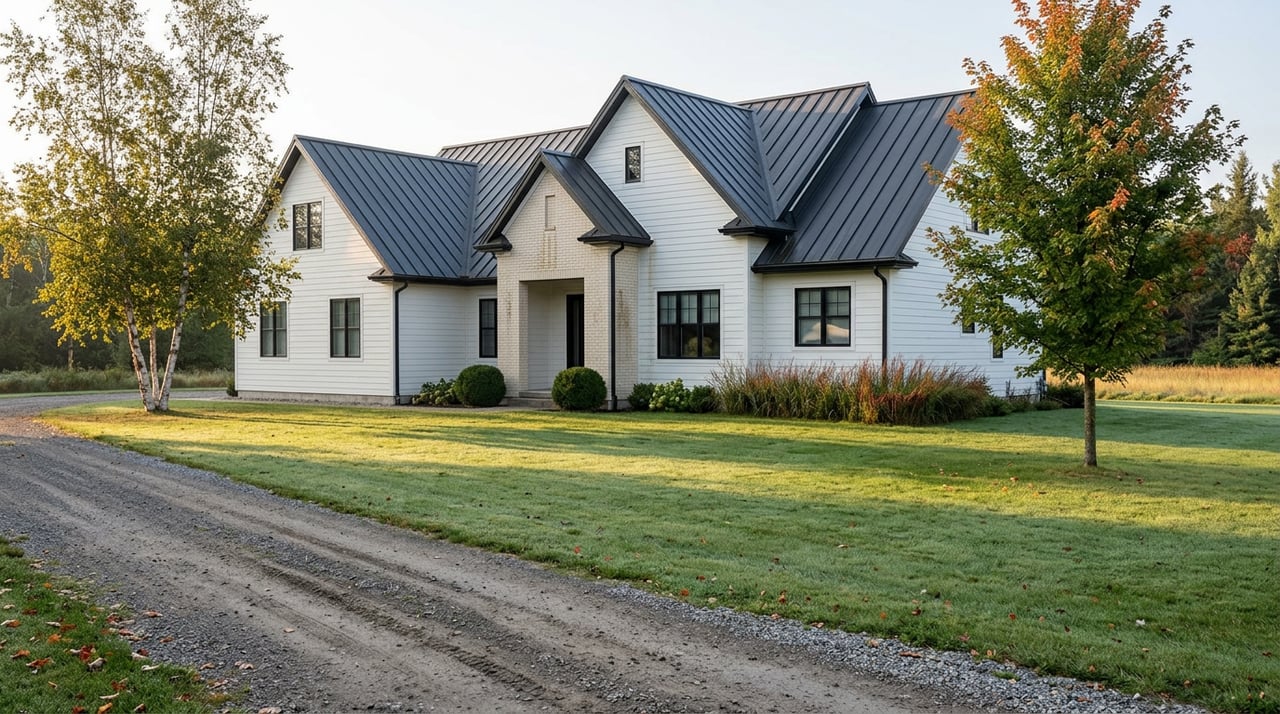
Franklin County's Home Prices Look Like a Deal Until You Read the Current Use Fine Print
Say you find twelve wooded acres outside Highgate for less than half of what a comparable lot would run in Chittenden County. The number looks like the win everyone told you Franklin County would be. Then your closing attorney mentions that six of those acres have been enrolled in Vermont's Current Use program for the past fifteen years, and, according to Vermont's Department of Taxes, pulling out even a modest homesite triggers a Land Use Change Tax equal to 10 percent of that land's fair market value. That bill doesn't show up on the listing sheet. It shows up at the closing table, and it can turn a bargain parcel into a break-even one.
This is the part of the Franklin County story that the headline median never tells you. The county really is cheaper than Chittenden. But "cheaper" is doing more work in that sentence than most buyers realize, and the fine print matters as much as the sticker price.
Coldwell Banker Hickok & Boardman's 2025 county-by-county market report, released in February 2026, put Chittenden County's median single-family sale price at $580,000 for the year, down about 1 percent from 2024, with homes averaging 32 days on the market. Franklin County's median for the same year came in at $400,000, up nearly 5.5 percent year over year, with homes taking roughly 50 days to sell.
Run that math and Franklin County sits about 31 percent below Chittenden. That gap held into 2026: over the three months ending in May, Franklin County's median sale price reached $412,000, up 9.8 percent from the same window a year earlier, with 49 homes sold that month against 44 the year before. Days on market stretched to 58, up from 27 the prior year, which tells you buyers are getting more time to think rather than getting outbid in a week.
So the 30-percent discount is real and it's holding. That's the part every relocation guide repeats. What most of them skip is that the number is an average of towns that don't behave anything alike.
Hickok & Boardman's Franklin County report breaks out what the countywide median is quietly blending. St. Albans City and Town anchor the county, carrying the highest sales volume, the most stable pricing, and the quickest market times of anywhere in Franklin County. Meanwhile, towns like Montgomery, Franklin, and Highgate saw noticeably softer pricing and longer marketing times over the same period, a pattern the report ties to increased buyer caution in the more rural parts of the county.
That split matters because a buyer comparing "Franklin County" to Chittenden County is often really comparing St. Albans, which behaves like a smaller, calmer version of a Chittenden suburb, to a scattered set of outlying towns where a listing might sit for months before anyone makes an offer.
| Segment | Market signal | What it means for a buyer |
|---|---|---|
| St. Albans City & Town | Highest volume, quickest sales, most stable pricing | Closest to a Chittenden-style market, just at a lower entry price |
| Montgomery, Franklin, Highgate | Softer pricing, longer time on market | More room to negotiate, but also more room for a listing to be stale or overpriced relative to what it will actually fetch |
| Franklin County overall | $400,000 median in 2025, climbing toward $412,000 by spring 2026 | A useful starting point for a budget conversation, a poor stand-in for what any specific address will cost |
If your search is anchored to St. Albans, the county median is a fair guide. If you're looking at acreage in the outlying towns, that same median can undersell how long a sale might take and oversell how firm the asking price really is.
The other place the county average breaks down is land. A lot of what makes Franklin County acreage cheaper than Chittenden County acreage is genuine: more supply, less commuter pressure, lower per-acre demand. But a meaningful share of that rural land carries a Current Use enrollment, Vermont's program that taxes qualifying forest and agricultural parcels at their productive value rather than their full market value. It's a real savings for the current owner.
Here's what that means in practice, according to Vermont's Department of Taxes:
None of this makes Current Use land a bad buy. It often means lower annual property taxes for as long as the enrollment stays in place, which is exactly why so much of Franklin County's rural acreage carries the designation in the first place. The issue is timing: a 10 percent tax on fair market value is a five-figure number on plenty of parcels, and it's much easier to plan for before you write an offer than to discover it during your final walk-through.
Put these two things together and the practical takeaway for anyone comparing Franklin County to Chittenden County isn't "it's 30 percent cheaper," it's "it's 30 percent cheaper on average, and the actual number for your parcel depends on which town you're in and whether that acreage comes with a tax obligation attached to it."
For a move-up buyer looking at St. Albans, that mostly means treating the county median as a reasonable planning number, since the city and town both track close to it with quick, stable sales. For a lifestyle or land buyer eyeing the quieter corners of the county, the softer pricing in places like Montgomery, Franklin, and Highgate can work in your favor at the negotiating table, but it's worth asking early whether a parcel is enrolled in Current Use and what withdrawing any part of it would actually cost. Your closing attorney or the town's Current Use Advisory contact can pull that history before you're under contract, not after.
Does the Land Use Change Tax apply to every rural lot in Franklin County? No. According to Vermont's Department of Taxes, it only applies to land currently enrolled in Vermont's Current Use program, which generally requires at least 25 contiguous acres of qualifying forest or agricultural land. A smaller parcel, or one that was never enrolled, won't carry this obligation. The town land records or the seller's tax bill will usually show whether a parcel is enrolled.
If I'm buying enrolled land and plan to keep farming or managing the forest, do I still owe the tax? Not automatically. If you take over the enrollment and keep the land in qualifying use, no change tax is due. The tax applies when land is withdrawn or developed, not simply when it changes owners.
Franklin County still offers real value against Chittenden County. The math just holds up better when you're looking at a specific town and a specific parcel instead of a single countywide number. If you're weighing a lot here against something closer to Burlington, or trying to figure out what a particular Franklin County acreage is actually going to cost once the paperwork is settled, Sherry Corbeil can walk through the town-by-town comparables and flag any Current Use questions before you're locked into an offer. Get a free valuation and start with numbers that hold up past the first showing.
This article is general information, not legal, tax or financial advice. Consult a qualified professional about your situation.
Stay up to date on the latest real estate trends.
Get assistance in determining current property value, crafting a competitive offer, writing and negotiating a contract, and much more. Contact me today.

116 SWANTON RD SAINT ALBANS VT 05478